
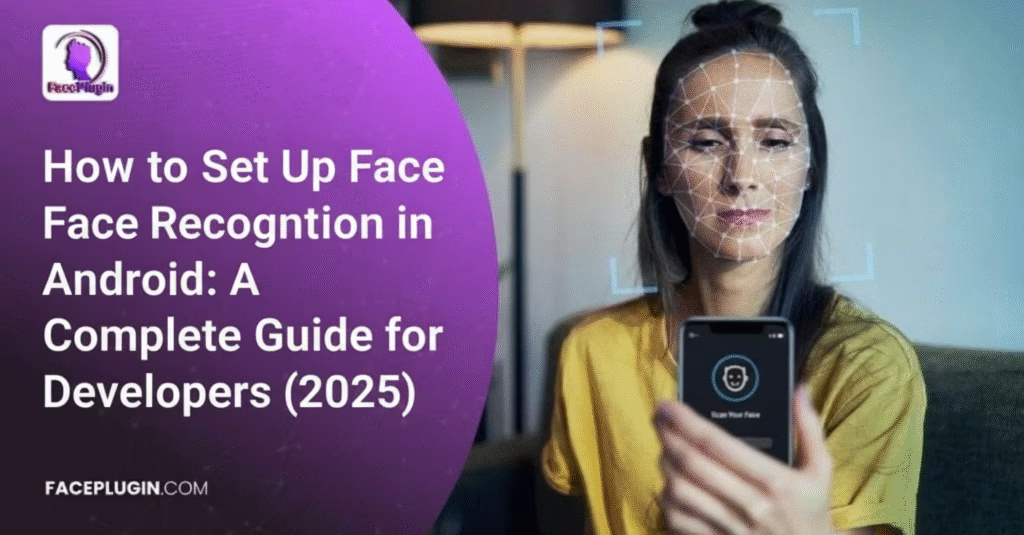
Face recognition in android is no longer a futuristic concept reserved for high-tech enterprises. Today, it powers everyday experiences: unlocking smartphones, verifying identity, recording attendance, securing digital transactions, and enhancing user experience across countless industries. Android, being the world’s most widely used mobile OS, is at the center of this transformation.
But despite this growing demand, developers often struggle with implementing accurate, secure, and real-time face recognition on Android. Challenges such as inconsistent lighting, device variations, spoofing attempts, and performance optimization can make the process difficult—unless you use the right tools.
This guide walks you through how to set up Android face recognition using the Faceplugin Android Face Recognition SDK, the most advanced on-device biometric engine designed for security-critical applications. Whether you’re building authentication, access control, attendance tracking, fintech KYC, or retail analytics, the Faceplugin SDK gives you everything you need.
This 4,000-word breakdown includes:
-
What face recognition is
-
Why Android developers choose Faceplugin
-
How the Faceplugin SDK works
-
Step-by-step instructions to set up face recognition in Android
-
Liveness detection, anti-spoofing & face feature embedding
-
Real-time face recognition example code
-
Best practices for accuracy and security
-
Production deployment guide
-
How Faceplugin supports industries worldwide
Let’s begin.
1. Understanding Face Recognition Technology in Android
Face recognition system on Android generally involves:
-
Face Detection – Locating faces in the camera feed
-
Face Alignment – Adjusting angle, rotation, and positioning
-
Face Embedding Extraction – Converting a face into a numeric vector
-
Face Matching – Comparing embeddings with a stored database
-
Liveness Detection – Ensuring the face is real, not spoofed
-
Decision Making – Grant access, verify identity, or authenticate
These steps traditionally require advanced AI knowledge, GPU optimization, and a lot of engineering effort. Faceplugin simplifies this into a ready-to-use SDK optimized for Android devices.
2. Why Faceplugin for Android Face Recognition?
Faceplugin provides a complete on-device face biometric stack that is:
✔ Fast
Optimized for CPU and mobile chipsets (MediaTek, Snapdragon, Exynos, Tensor).
✔ Accurate
Industry-leading face recognition accuracy across all ethnicities and lighting environments.
✔ Secure
On-device processing means biometric data never leaves the device.
✔ Anti-Spoofing Ready
Detects:
-
Printed photos
-
Digital screens
-
Video replays
-
3D masks
-
Deepfakes
✔ Lightweight
Small SDK size, runs on low-end and high-end Android devices.
✔ Easy to Integrate
Java, Kotlin, and cross-platform frameworks supported:
-
Android (Java/Kotlin)
-
Flutter
-
React Native
-
Expo
-
Ionic/Cordova
-
.NET MAUI
-
Xamarin
-
Unity
-
And server SDKs (Linux, Windows, Docker)
3. Setting Up Face Recognition in Android (Step by Step)
This section shows how to install, configure, and use Faceplugin’s Android Face Recognition SDK.
Step 1: Download the Faceplugin Android SDK
You will receive:
-
faceplugin.aaror.jarfiles -
Model files (
.bin,.param) -
License key
-
Android sample project
Place the SDK in your project under:
Then add the path to build.gradle.
Step 2: Add Dependencies
Gradle (Module: app)
Step 3: Initialize Faceplugin SDK
Kotlin Example
AndroidManifest.xml
Step 4: Set Up Camera Preview
Faceplugin SDK works with CameraX.
Step 5: Process Frame & Detect Faces
Step 6: Extract Face Embeddings
Embeddings are 128–512-dimensional vectors.
Store the embeddings in:
-
SQLite
-
Room database
-
Server database
-
Offline encrypted storage
Step 7: Perform Face Matching
Threshold depends on your use case.
4. Adding Liveness Detection (Anti-Spoofing)
Faceplugin provides:
Passive Liveness
No user actions required.
Detects attacks:
-
Printed Photos
-
Digital Screens
-
Video Replays
-
3D Masks
-
Deepfake videos
Active Liveness
User performs actions:
-
Blink
-
Smile
-
Move head
-
Look left / right
Code Example
5. Real-Time Face Recognition Implementation
Combine detection + embedding extraction + matching.
6. Optimizing Accuracy on Android
To improve results:
✔ Use front camera
Higher quality for facial features.
✔ Ensure good lighting
Avoid strong backlight.
✔ Capture full face
Eyes, nose, and mouth should be clearly visible.
✔ Encourage natural expression
Neutral face gives best embeddings.
✔ Keep camera steady
Motion blur decreases accuracy.
✔ Use Faceplugin’s built-in face alignment
It improves recognition.
7. Face Recognition vs. Liveness vs. Embedding Extraction
| Function | Purpose | Required? |
|---|---|---|
| Face Detection | Detect face in frame | Yes |
| Embedding Extraction | Convert face to vector | Yes |
| Face Matching | Compare embeddings | Yes |
| Passive Liveness | Detect spoofing | Recommended |
| Active Liveness | Strong security | Optional |
| Anti-Spoofing 3D Mask Detection | Prevent high-end attacks | For banking |
| Deepfake Detection | Prevent synthetic video attacks | For KYC |
Faceplugin provides all of the above in a single SDK.
8. Building a Face Authentication UI (Example)
Login Flow:
-
Open camera
-
Detect face
-
Check liveness
-
Extract embedding
-
Match with stored embedding
-
Authenticate user
Sample Pseudocode
9. Deploying Face Recognition in Production
Follow these best practices:
1. Store embeddings securely
Use AES encryption or Keystore API.
2. Avoid storing images
Store only embeddings.
3. Use on-device processing
Faceplugin ensures no cloud vulnerabilities.
4. Enable anti-spoofing
Mandatory for fintech & attendance systems.
5. Monitor performance
Check latency, FPS, and CPU usage.
6. Test across many devices
Low-end and high-end Android devices behave differently.
10. Use Cases for Android Face Recognition
✔ Mobile Attendance Systems
Replace manual attendance with face recognition.
✔ Identity Verification (KYC)
Banks, fintech apps, and digital onboarding.
✔ Access Control
Doors, gates, locker systems, and smart offices.
✔ Workplace Management
Employee authentication and time tracking.
✔ Retail Analytics
Customer demographic analysis (age, gender, emotion).
✔ Smart Apps
Photo enhancement, AR filters, avatar creation.
11. Why Developers Love Faceplugin Android SDK
Fast Integration
Under 30 minutes.
Small SDK Size
Ideal for lightweight apps.
High Accuracy
Trained on millions of diverse faces.
High Security
Anti-spoofing and deepfake-resistant.
Flexible Licensing
SaaS, on-premise, OEM, and perpetual licenses.
Supports All Android Versions
From Android 5.0 to Android 15.
Cross-Platform Friendly
One model works across Android, Flutter, iOS, and more.
12. Faceplugin Android SDK Features (Complete List)
Face Recognition
-
Identification (1:N)
-
Authentication (1:1)
-
Verification
Liveness Detection
-
Passive
-
Active
-
Multi-modal
Anti-Spoofing
-
Printed paper detection
-
Screen replay detection
-
3D mask detection
-
Deepfake detection
Face Attributes
-
Age
-
Gender
-
Eye closeness
-
Emotion / facial expressions
-
Head pose
Facial Feature Embedding
-
128D / 256D / 512D vectors
Face Quality Assessment
-
Blur detection
-
Illumination check
-
Occlusion detection
Video Recognition
-
Real-time face tracking
-
Real-time recognition
13. Example: Employee Attendance App Using Faceplugin
Workflow:
-
User registers their face
-
Embeddings stored locally or server
-
During attendance:
-
Detect face
-
Check liveness
-
Extract embedding
-
Match with database
-
Log attendance with timestamp
-
Perfect for:
-
Offices
-
Schools
-
Construction sites
-
Hospitals
-
Factories
14. FAQs
1. Does Faceplugin work offline?
Yes. 100% on-device processing.
2. Can it detect photos or fake videos?
Yes. Advanced anti-spoofing + deepfake detection.
3. How accurate is Faceplugin?
99.8% accuracy across global datasets.
4. Can it work on low-end devices?
Yes, optimized for low-memory mobile CPUs.
15. Final Thoughts
Android developers today need reliable, secure, and high-performance biometric technology. Faceplugin provides all the components required to build world-class face recognition apps — without spending years on AI research.
Whether your goal is:
-
user authentication
-
employee attendance
-
KYC verification
-
access control
-
customer analytics
Faceplugin’s Android Face Recognition SDK offers unmatched accuracy, speed, and security.
If you’re ready to integrate face recognition into your Android app, Faceplugin gives you:
✔ Fast integration
✔ High accuracy
✔ Strong anti-spoofing
✔ Lightweight SDK
✔ Works on any Android device
✔ Enterprise-grade reliability